


Lebanon has been a refuge for diverse peoples and religious groups since ancient times. Christians have been rooted there for more than 2,000 years, and remained even as the region became the centre of Islamic empires.
Their influence grew over the centuries and reached a high point with the creation ofGreater Lebanonin 1920, with help fromFrancethe country in charge under aninternational mandate.
During this period, France drew Lebanons modern borders and introduced state institutions that shaped the early administration, courts and security forces. Christian influence was thus anchored in the founding texts of the Lebanese Republic in 1943.
Today, after years of outside control bySyriaandIsrael, civil wars, economic collapses and the Beirut port explosion, Christians still hold leading roles in a country struggling to hold itself together.
From protector to onlooker: how France lost its influence in Lebanon
Sharing power
While the Christian clans did not win the1975-1990 civil war, which killed 150,000 people, nor did the Taif peace agreement push them out of power.
It reorganised state institutions to reflect demographic change, including faster growth amongMuslimcommunities and a shrinkingChristianpopulation caused by emigration and lower birth rates. The Taif Agreement also shifted a large share of the presidents powers to the cabinet.
Even with these changes, the revised constitution of 1990 which amended 31 articles kept strict parity between Muslims and Christians across state institutions. The cabinet and parliament, senior civil service roles, the judiciary and the top ranks of the army and security forces all follow this rule.
The government, as the core of the executive, still has equal numbers of Muslim and Christian ministers.
Taif also reaffirmed the unwritten 1943National Pact, which says the president must be a Maronite Christian, the prime minister aSunniMuslim and the speaker of parliament aShiaMuslim.
That rule has held ever since, except for a short period in the late 1980s when outgoing president Amine Gemayel appointed army chief Michel Aoun, a Maronite, as prime minister. Muslim leaders rejected the move and continued to recognise the Sunni prime minister Salim el Hoss, leaving Lebanon with two rival governments.
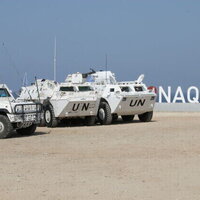
France's Macron hails UN decision to extend peacekeeping mission in Lebanon
Christians in key posts
Maronites continue to hold many of the states top positions inLebanon. The army commander is always a Maronite, as are the governor of the Bank of Lebanon, the president of the Supreme Judicial Council, the director general of customs and the head of the central inspection body. Many other senior roles also go to members of the Christian community.
Parity is strictly applied in parliament, which elects the president. The chamber has 128 members, split equally between Christians and Muslims. Maronites hold 34 of the 64 Christian seats, making them the largest Christian bloc. Sunnis and Shias each have 27 seats, while Druze deputies have eight and Alawites who follow Alawism, an offshoot of Shia Islam have two.
The deputy speaker is always a Greek Orthodox member.
Five years after Beirut port explosion justice and recovery remain elusive
Courts and the army
The judiciary mirrors this balance. The Supreme Judicial Council is led by a Maronite. The prosecutor general is always a Sunni and the head of the financial prosecution office is a Shia. Christians hold half of all regional prosecutor posts. The countrys top court, the Court of Justice, is also chaired by a Maronite.
The military applies parity at officer level, though the most senior posts remain in Maronite hands. These include the heads of military intelligence, operations and other top functions. Among lower ranks, Sunnis and Shias are believed to outnumber Christians by about two to one, although no official figures exist.
The modern army traces part of its structure back to the mandate-era Troupes Spciales, an early force set up under French command.
Macron hosts Lebanon's president, reiterating French support for 'sovereignty'
Economic weight
Meanwhile, Christians also lead several major economic bodies. The Association of Industrialists, the Union of Insurance Companies, the Association of Business Leaders and the powerful Association of Banks are all headed by Christians even though their statutes do not require it.
Some professional organisations, such as the Bar Association, are also traditionally led by Christians.
If power were shared according to population size, Christians would hold far fewer posts. The last census was carried out in 1932 none have been held since because counting religious groups is seen as too politically sensitive an exercise.
Discussion of what Lebanese people call "the count" remains taboo, but it is widely acknowledged that Christians now make up no more than a quarter of the population. TheMaronite Churchremains one of the countrys largest landowners despite the fall in its number of followers.
'A new social contract'
Many Lebanese people, both Christian and Muslim, say the existing system cannot continue indefinitely.
In October 2019, thousands of Lebanese from all religious communities took to the streets demanding a change to the current power-sharing system. For five months, demonstrations were held in many cities under the slogan "kellon yani kellon", meaning "all of the political class, regardless of sect, must go".
Thats a fundamental break from the past. The Lebanese aspire to a new social contract not based on clientelism and sectarianism,French-Lebanese Middle East analyst Karim Bitartold The Times of Israel at the time.
The most recent United States governmentReport on International Religious Freedomfor Lebanon, from 2023, identified "exacerbated sectarian tensions" and warned that the countrys long-standing commitment to pluralism is facing unprecedented strain.
This story was adapted from theoriginal versionin French byPaul Khalifehin Beirut.
Originally published on RFI